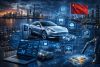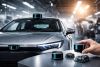
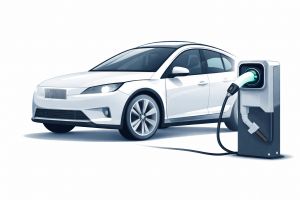
By January 2026, China’s automotive sector is undergoing a profound transformation. The industry is moving beyond traditional vehicle manufacturing toward what Chinese executives increasingly describe as “Physical AI”—the fusion of autonomous driving, robotics, and real-world AI systems spanning cars, cities, and humanoid machines.
Strategic Shift Toward Physical AI
A defining trend is the repositioning of major automakers as AI-first companies. XPeng, for example, now openly defines itself as a physical AI enterprise rather than a car manufacturer. The company plans to begin mass production of its Ironhumanoid robots in the second half of 2026, while street trials of its AI-powered robotaxi service are expected to begin imminently.
At the same time, China is accelerating real-world deployment of advanced autonomy. In late December 2025, regulators approved the country’s first Level 3 (hands-off) autonomous driving models. Brands such as Deepal and BAIC Arcfoxreceived the first special license plates authorizing Level 3 public-road testing.
Robotaxi Expansion Accelerates
Robotaxi programs are moving from pilots to scale. In January 2026, Pony.ai and BAIC BJEV launched their “Cooperation 2.0” initiative, targeting the deployment of 3,000 Level 4 robotaxis by the end of the year. The program reflects growing confidence that fully driverless services are nearing commercial viability in selected Chinese cities.
Major Brand and Technology Developments in 2026
Several leading manufacturers used early 2026 to showcase AI-driven strategies:
Geely unveiled its G-ASD (Geely Afari Smart Driving) system at CES 2026. This AI-centric driving architecture is being rolled out across 16 models under the Zeekr and Lynk & Co marques. Geely is also integrating DeepSeek AI into its connected vehicle ecosystem.
Xiaomi, following a breakout year in 2025, set a 2026 target of 550,000 EV sales. The company reached profitability faster than Tesla, reinforcing its reputation for rapid execution and cost efficiency.
BYD, which overtook Tesla in global EV sales in 2025 (2.26 million vehicles versus 1.64 million), is launching the Linghui sub-brand in 2026. The new marque is focused specifically on ride-hailing and fleet customers.
Volkswagen, under its “In China, for China” strategy, plans to introduce Level 2++ Urban Navigate on Autopilot (NoA) in 2026. The system has been developed exclusively for Chinese traffic conditions and regulatory requirements.
Market Pressures and Structural Challenges
The rapid rise of AI-driven mobility is unfolding amid intense market pressures. Persistent price wars prompted Chinese authorities to draft tighter regulations in late 2025, as dealership inventories climbed to an average 47-day supply.
At the same time, AI is reshaping vehicle development itself. Chinese manufacturers increasingly rely on platforms such as Neural Concept to shorten design cycles by as much as 30%. This speed advantage is placing significant pressure on Western legacy automakers to accelerate product development.
Despite mounting tariffs in the US and Europe, exports continue to surge. China’s vehicle exports reached a record 728,000 units in November 2025, representing a 49% year-on-year increase—underscoring the global impact of China’s shift toward Physical AI–driven mobility.